

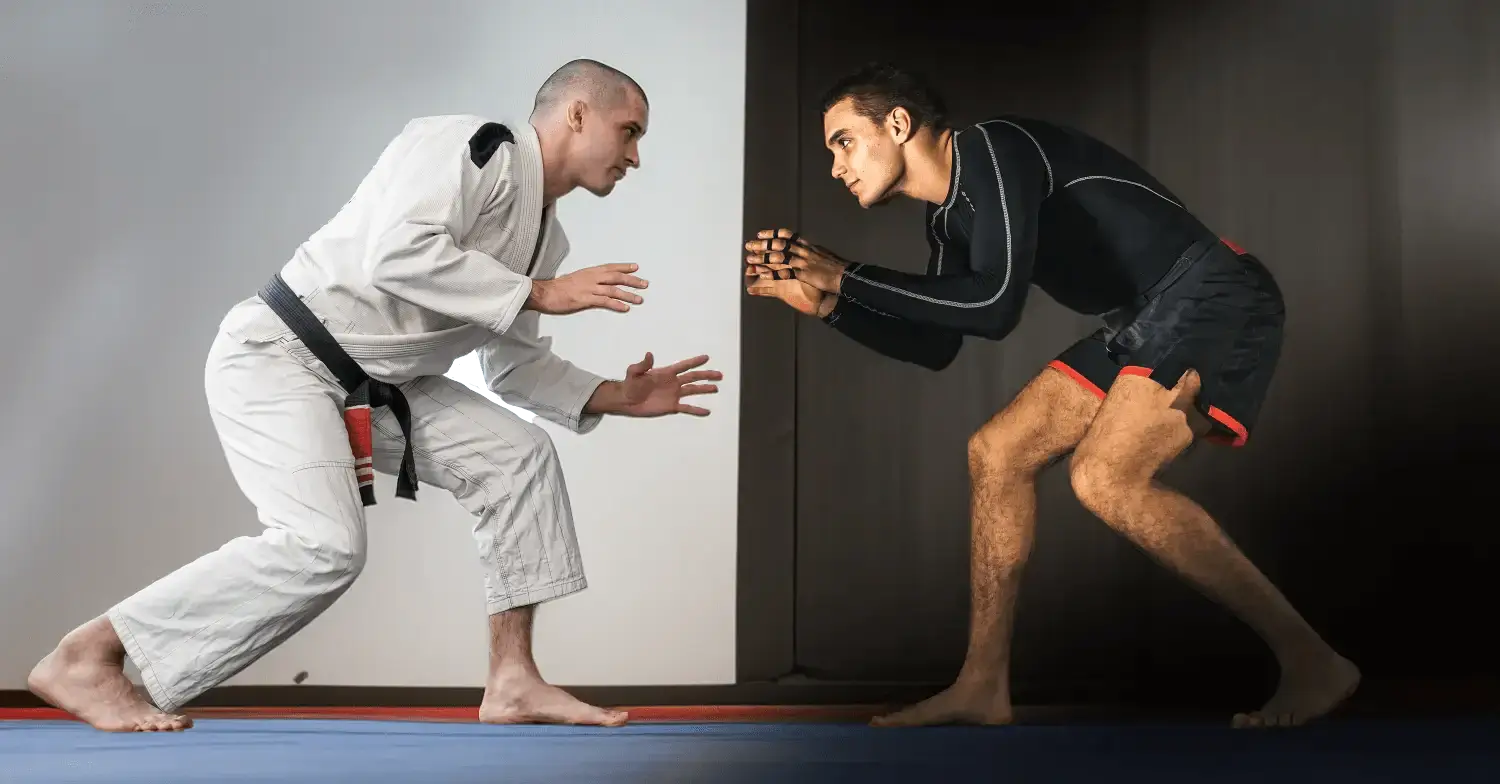
Quick answer: gi BJJ is trained in a heavy cotton jacket, pants and belt that both athletes are allowed to grip. No-gi is trained in a rash guard and shorts that cannot be grabbed. The gi makes the game slower and more grip-driven, with dozens of collar and lapel chokes. No-gi is quicker and more slippery, relies on body control and wrestling-style ties, and in many rule sets opens up a wider range of leg locks at the higher belts. Neither one is "better". Most coaches recommend training both, then leaning towards no-gi if MMA is your main goal.
Brazilian Jiu-Jitsu grew out of the judo and jiu-jitsu that Japanese teachers, most famously Mitsuyo Maeda, brought to Brazil in the early twentieth century, so for decades the kimono-style gi was simply the uniform. That changed as BJJ became a core skill in mixed martial arts and as submission grappling events such as ADCC took off. Today almost every academy in Australia runs both gi and no-gi classes, and the same question comes up from nearly every new student: which one should I train? This guide covers what actually changes when the jacket comes off, how the competition rules differ, which style suits beginners, self-defence and MMA, and what to wear for each.
Contents
- Gi vs no-gi at a glance
- What is the difference between gi and no-gi?
- How the clothing changes the way you roll
- Gi vs no-gi competition rules
- Is gi or no-gi better for beginners?
- Is gi or no-gi better for self-defence?
- Is gi or no-gi better for MMA?
- Are there gyms that only teach no-gi?
- Gi and no-gi pros and cons
- What to wear for gi and no-gi
- Gi vs no-gi FAQ
Gi vs no-gi at a glance
| Gi | No-gi | |
|---|---|---|
| What you wear | Cotton jacket, pants and a coloured rank belt | Rash guard and grappling shorts, often with spats underneath |
| What you can grip | Collar, lapels, sleeves, pants and belt, as well as the body | The body only: wrists, head, neck, underhooks, overhooks and body locks |
| Pace | Slower and more methodical, because the fabric creates friction | Faster, with more scrambles and transitions |
| Submissions | Everything in no-gi plus a large family of collar, lapel and sleeve chokes | Fewer chokes; leg locks play a bigger role at the higher belts |
| Typical guards | Spider, lasso, De La Riva, collar-and-sleeve and lapel guards | Butterfly, half guard, single-leg X and other leg entanglements |
| Role of athleticism | Grips and friction let technique slow a stronger partner down | Speed, explosiveness and wrestling tend to matter more |
| Main competition formats | IBJJF-style gi divisions at most local and international opens | IBJJF no-gi divisions, ADCC-style events and submission-only events |
| Crossover to MMA | Indirect | Direct |
| Kit and laundry | Heavier, slower to dry, needs the right size for shrinkage | Light, quick-drying and easy to pack |
What is the difference between gi and no-gi?
At its simplest, the difference is clothing. A BJJ gi descends from the judo uniform: a thick woven cotton jacket with a reinforced collar, matching pants with a drawstring or elastic waist, and a cotton belt whose colour shows your rank. If you're curious how those colours work, our guide to BJJ belt progression explains each step. Jackets come in different weaves and weights, from light competition cuts to heavy training gis, and in everything from basic training models to premium gis made to an academy's own design.
No-gi clothing looks more like surf or gym wear. Most people train in fitted rash guards, in short or long sleeves, with grappling or board shorts and often compression spats underneath. Everything is made from stretchy synthetic fabric such as polyester and elastane, so it moves with you, dries quickly and gives your partner nothing useful to hold.
The rank system doesn't disappear in no-gi. Many academies keep belts on the wall rather than around the waist, and some competitions ask for rash guards whose colour reflects your belt. The skills you're graded on are the same jiu-jitsu either way.
How the clothing changes the way you roll
In the gi you can use both your own and your partner's uniform. A collar grip can control posture, a sleeve grip can stop an arm from posting, a pant grip can slow a leg down, and a lapel can be fed around the body to build a choke or a guard. In no-gi none of these handles exist. Control has to come from your body: underhooks and overhooks, wrist control, head position, body locks and balance.
John Danaher, one of the most influential coaches in the sport, has argued that the gi tends to build defensive skill while no-gi tends to build offensive skill. His reasoning comes down to three changes:
1. Friction
A cotton gi grabs at everything, especially once it's soaked with sweat. That friction slows exchanges down. You can't simply outrun a position, so you learn to deal with each obstacle in turn: clear the grip, fix your posture, then move. In no-gi, sweat and synthetic fabric make everyone slippery. Exchanges happen faster, escapes that would stall in the gi often succeed, and a fast, athletic partner can cover technical gaps more easily.
2. Grips
Without collars, sleeves and pant legs to hold, holding someone down and finishing a submission demands much better positioning. You can't lean on a cross-collar grip to keep someone flat; you have to get your hips, chest and head in the right places. This is the main reason many coaches say no-gi sharpens attacking technique: it removes the shortcuts.
3. Chokes
The gi jacket gives your partner a huge number of ways to strangle you, from cross-collar chokes in guard to lapel chokes from the back. As a result, gi students learn to protect their neck almost from day one. Take the jacket away and the number of available chokes drops sharply, leaving the rear naked choke, guillotine, triangle, arm triangle, darce and a few others. Those remaining chokes demand cleaner mechanics, because there's no fabric to tighten them.
Leg locks and the no-gi game
There is one more practical difference. Because heel hooks and knee reaping have long been allowed in many no-gi and submission grappling rule sets, the modern no-gi game revolves around leg entanglements far more than the gi game does. If you train no-gi seriously, expect to learn leg-lock entries and defence early. Our overview of Brazilian Jiu-Jitsu submissions covers the main leg locks alongside the chokes and arm locks.
Gi vs no-gi competition rules
Two rule differences matter most when you move between gi and no-gi divisions:
- Gripping clothing. In the gi you may grip the uniform, within limits; for example, IBJJF rules restrict some grips inside the sleeve or pant cuff. In no-gi you cannot grip your opponent's rash guard or shorts at all.
- Leg locks. Under current IBJJF rules, heel hooks and knee reaping are not permitted in the gi at any belt, but in IBJJF no-gi they are allowed for brown and black belts. Other organisations draw the line in different places, so check your competition's rules for your belt and age division.
Scoring is usually the same in both: under the IBJJF system a takedown or sweep scores 2 points, a guard pass 3, and mount or back control 4. Our guide to BJJ points explains every scoring action, along with advantages and penalties.
There's no shortage of events in either style. The International Brazilian Jiu-Jitsu Federation (IBJJF), one of the largest organisers in the world, runs separate gi and no-gi divisions at many of its tournaments and holds world championships for both every year. Many other tournament series, including those run in Australia, offer gi and no-gi brackets on the same day.
Submission grappling has its own scene too. The Abu Dhabi Combat Club (ADCC) World Championship, held every two years with regional trials in between, is the best-known no-gi grappling event. Its rules permit heel hooks and reward takedowns and aggressive play, and it has done a lot to shape how the modern no-gi game looks. Submission-only events, where there are no points and the match is won by tap or by overtime rules, have pushed the leg-lock game even further.
Because these rule sets differ in what's legal, how matches are scored and what you must wear, always read the rules for the specific event before you enter.
Is gi or no-gi better for beginners?
It depends on why you're training. If your academy runs both, the most common advice from black belts, including world champions such as Bernardo Faria, is to do both regularly. Danaher reached a similar view: the gi teaches beginners defensive habits such as protecting the neck, while no-gi forces them to build attacks that work without grips to hold the position.
A few practical points for new students:
- Follow your timetable. Many Australian academies run more gi classes than no-gi classes, especially in their fundamentals program. Train the style that lets you get on the mat most consistently.
- Expect the gi to feel slower. Beginners often find the gi easier to follow because the pace gives them time to think, and grips give them something to hold onto.
- Expect no-gi to feel more athletic. If you come from wrestling or MMA, no-gi will feel familiar straight away.
- The fundamentals are shared. Positions, escapes and the core submissions work in both. Our guide to BJJ positions covers the foundations every beginner needs, whichever uniform they wear.
If MMA is your only reason for starting, many MMA coaches, Firas Zahabi among them, have suggested putting most of your grappling time into no-gi (more on that below).
Is gi or no-gi better for self-defence?
Opinions are split, and both sides make fair points.
The case for no-gi. Eddie Bravo, founder of the no-gi organisation 10th Planet Jiu-Jitsu, argues that no-gi is closer to a real confrontation. You can't rely on someone wearing a thick jacket, and in summer, at the beach or in a gym, they may be wearing very little. A no-gi game built on head control, underhooks and body locks works whatever the other person has on.
The case for the gi. Others point out that the gi is, in effect, a jacket and pants, and that most people in the street are wearing clothes that can be gripped. Coaches such as Nick "Chewy" Albin of the Chewjitsu channel have made this argument: learning to use and defend against clothing grips is relevant to real life, arguably more so than training in tight synthetic fabric. The extra emphasis on neck defence in the gi is also useful.
The practical answer. For self-defence, what matters most is controlling someone, getting back to your feet and dealing with strikes, not the uniform. Training both covers more situations. Whichever you choose, look for an academy that teaches standing control and self-defence fundamentals as well as sport jiu-jitsu, and practise takedown defence; our guide to BJJ takedowns and throws is a good place to start.
Is gi or no-gi better for MMA?
For MMA, most coaches recommend prioritising no-gi. Firas Zahabi, the long-time head coach at Tristar Gym in Montreal, has explained his reasoning: many gi-specific techniques, particularly collar chokes and guards that depend on sleeve and lapel grips, don't carry over to a fight where nobody wears a jacket. Time spent perfecting them is time not spent on wrestling, striking and clinch work, which MMA also demands.
No-gi translates more directly because its control comes from the same ties used in MMA: underhooks, overhooks, wrist control, head position and body locks. Its faster pace and greater emphasis on getting up from the bottom also suit a fight with strikes.
That doesn't make the gi useless for fighters. Zahabi himself has said the gi is valuable for developing escapes and stopping guard passes, because the friction and grips make both harder. Some fighters keep one gi session a week for exactly that reason. If you're kitting out a fight team, our custom MMA and no-gi team kit is designed for that kind of training.
Are there gyms that only teach no-gi?
Yes. The best-known example is 10th Planet Jiu-Jitsu, founded by Eddie Bravo in the early 2000s and now running affiliate schools in many countries. Bravo removed the gi entirely because he wanted a style built around clinching and controlling the body rather than pulling on fabric, which he believed made the art more effective once strikes were involved. His school is also known for the "rubber guard", a high closed-guard system designed for no-gi and MMA.
Plenty of other academies, as well as MMA gyms, run no-gi-only programs. Even so, most BJJ academies still teach both, and many still run more gi classes. If no-gi is your priority, check the timetable before you sign up.
Gi and no-gi pros and cons
Gi
Pros
- A much larger range of grips, guards, sweeps and chokes to learn
- Friction and grips make escaping harder, which builds patient, technical defence
- A slower pace that gives beginners time to think and lets technique slow down a bigger, stronger partner
- Most academies offer plenty of gi classes, and most local tournaments run gi divisions
Cons
- Friction and grips can hide sloppy positioning and submission mechanics
- Some gi-specific techniques don't translate to no-gi or MMA
- Gis are heavier to carry, slower to dry and need the right size to allow for shrinkage
No-gi
Pros
- Without grips to rely on, you have to develop precise positioning and strong attacks
- Translates directly to MMA and other grappling sports
- A faster, more athletic pace that's great for conditioning
- Light, cool kit that suits hot Australian summers and is easy to wash
Cons
- Fewer grips and less friction mean defence can be less thoroughly tested
- Speed and athleticism can cover technical gaps, so bad habits sometimes go unnoticed
- Leg-lock-heavy rule sets mean you need to learn leg-lock defence early to train safely
- Fewer academies are no-gi only, and some run limited no-gi timetables
What to wear for gi and no-gi
For gi classes you need a jacket and pants that fit you properly after washing, plus a belt. Most academies accept white, blue or black gis, and IBJJF competition rules also limit gi colours to white, royal blue or black. Because cotton shrinks, size matters more than it seems; our BJJ gi size charts explain how to choose. Many people also wear a rash guard under the jacket for comfort and hygiene.
For no-gi classes you need a fitted rash guard and shorts designed for grappling, ideally with a secure waist and no zips, pockets or exposed hard parts that could catch fingers and toes. Spats are optional but popular because they reduce mat burn and skin contact. Competitions often have extra requirements, such as long-sleeve or belt-coloured rash guards, so check your competition's rules before you enter.
Whatever you wear, keep it clean. Wash both gi and no-gi gear after every session and dry it fully to cut down on skin infections and odour.
If your academy wants matching gi and no-gi kit in its own colours and logo, see our custom academy uniforms. For more of the language you'll hear in class, our list of BJJ terms every grappler should know is a handy companion.
Gi vs no-gi FAQ
Is gi or no-gi better for beginners?
Neither is better for everyone. If your academy offers both, training both is the most common advice. The gi tends to teach patient defence, especially neck protection, while no-gi forces you to build precise positioning and attacks. If MMA is your main goal, lean towards no-gi.
Is no-gi easier than gi?
Not really, it is just different. No-gi has fewer grips and chokes to learn, which can make it feel simpler at first, but the faster pace and lack of friction make positions harder to hold. The gi has more techniques but a slower pace that many beginners find easier to follow.
Are heel hooks allowed in gi BJJ?
Under current IBJJF rules, heel hooks are not allowed in the gi at any belt. In IBJJF no-gi they are allowed for brown and black belts, and many ADCC-style and submission-only events allow them more widely. Rules vary by organisation, belt and age division, so check your competition's rules.
Is no-gi better for MMA?
For most people, yes. No-gi control comes from underhooks, overhooks, wrist control and head position, the same ties used in MMA, while many gi techniques rely on collar and sleeve grips that do not exist in a fight. Some fighters still train in the gi to sharpen their escapes and guard retention.
What do I wear to a no-gi BJJ class?
Wear a fitted rash guard and grappling shorts without zips, pockets or hard parts, with spats underneath if you like. Avoid loose T-shirts and shorts with drawstrings that can catch. Competitions may require specific sleeve lengths or colours, so check the rules before you enter.
Does training in the gi help your no-gi?
Yes, and the reverse is true too. Positions, escapes and most submissions work in both. The gi builds patience and defence under heavy grips, while no-gi sharpens positioning and speed. Many top grapplers train both because each style exposes weaknesses the other can hide.

Share:
BJJ Terms Glossary: 120+ Jiu-Jitsu Terms from A to Z
BJJ Quotes: Jiu-Jitsu Wisdom from the Gracies, Danaher and More